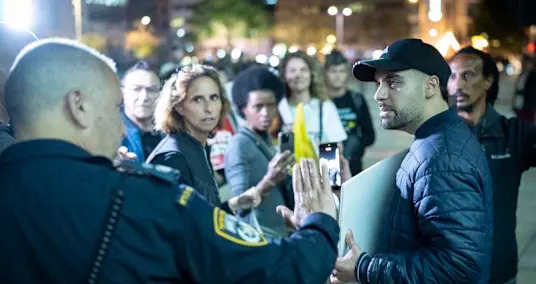
Protests took place in Tel Aviv, Jerusalem, Haifa, and Beersheba, as a survey found broad but uneven support among Jewish Israelis for Operation Roaring Lion.
Israel Police arrested 21 anti-war protesters Saturday night as demonstrations against the conflict with Iran expanded in multiple cities despite restrictions on public gatherings.
Protests took place in Tel Aviv, Jerusalem, Haifa, and Beersheba, with hundreds of participants reported in Tel Aviv and Jerusalem and about 100 in Haifa, marking the largest turnout since weekly demonstrations began. Authorities said 13 people were arrested in Tel Aviv and eight in Haifa.
Police said the gatherings were not approved under Home Front Command regulations that ban events with more than 50 people. Officials said the increase in turnout followed calls by groups opposing the government to protest despite the restrictions.
“During a situation assessment that took place at the scene with a Home Front Command representative… it was clarified that there was a real risk to human life and accordingly, Yarkon [precinct] police commander Tzachi Sharabi ordered the gathering to be dispersed,” police said.
Hadash-Ta’al chairman Ayman Odeh, an Arab lawmaker involved in the protests, criticized the police response, calling officers fascists “in the service of the government” and saying they were afraid of “the heroic citizens who went out, despite everything, to make their voice heard.”

Survey shows broad, uneven support for war
The demonstrations come as a March 2026 survey by the Israel Democracy Institute found broad but uneven support among Jewish Israelis for Operation Roaring Lion. Support was strongest on the Right at 87% and about half on the Left.
The survey also found that Jewish and Arab respondents largely agreed that Iran’s resilience has been stronger than expected. Most Jewish respondents said Israeli society could sustain the campaign for up to one month, while 28% said as long as needed. Arab respondents were less optimistic about how long the public could endure the conflict.
A majority of Jewish respondents said Prime Minister Benjamin Netanyahu’s decision was driven by security considerations, while most Arab respondents viewed it as political.
latest_posts
- 1
 UNICEF: More than 100 children killed in Gaza since ceasefire
 - 2Discovery of ancient pleasure boat reveals Egypt's maritime history
- 3Fact Check: Some Bridge Photos Circulating Do NOT Show The Hongqi Bridge That Collapsed In Southwest China Nov. 11, 2025
- 4'Women on the floor, riddled with bullets': Ex-hostage Rom Braslavski recounts 'horrors' of Oct. 7
- 5Vote In favor of Your Favored Occasion Arranging Administration


- PHOTO ESSAY: Scientists trying to unravel one of the body's biggest mysteries
- A mom's viral post is raising the question: Do kids need snacks? Dietitians have answers.
- Four Dead in Last Month From Animal Attacks in Nepal
- Home Wellness Basics: Building Your Home Exercise center
- Famous Restroom Beautifying Styles For 2024
- Russian military plane crashes in annexed Crimea, killing 29 people on board
- I’m a neuroscientist who taught rats to drive − their joy suggests how anticipating fun can enrich human life
- Air travelers face higher ticket prices as Iran war drives up oil prices
- Finding Ideal Date Spots for Two or three Encounters